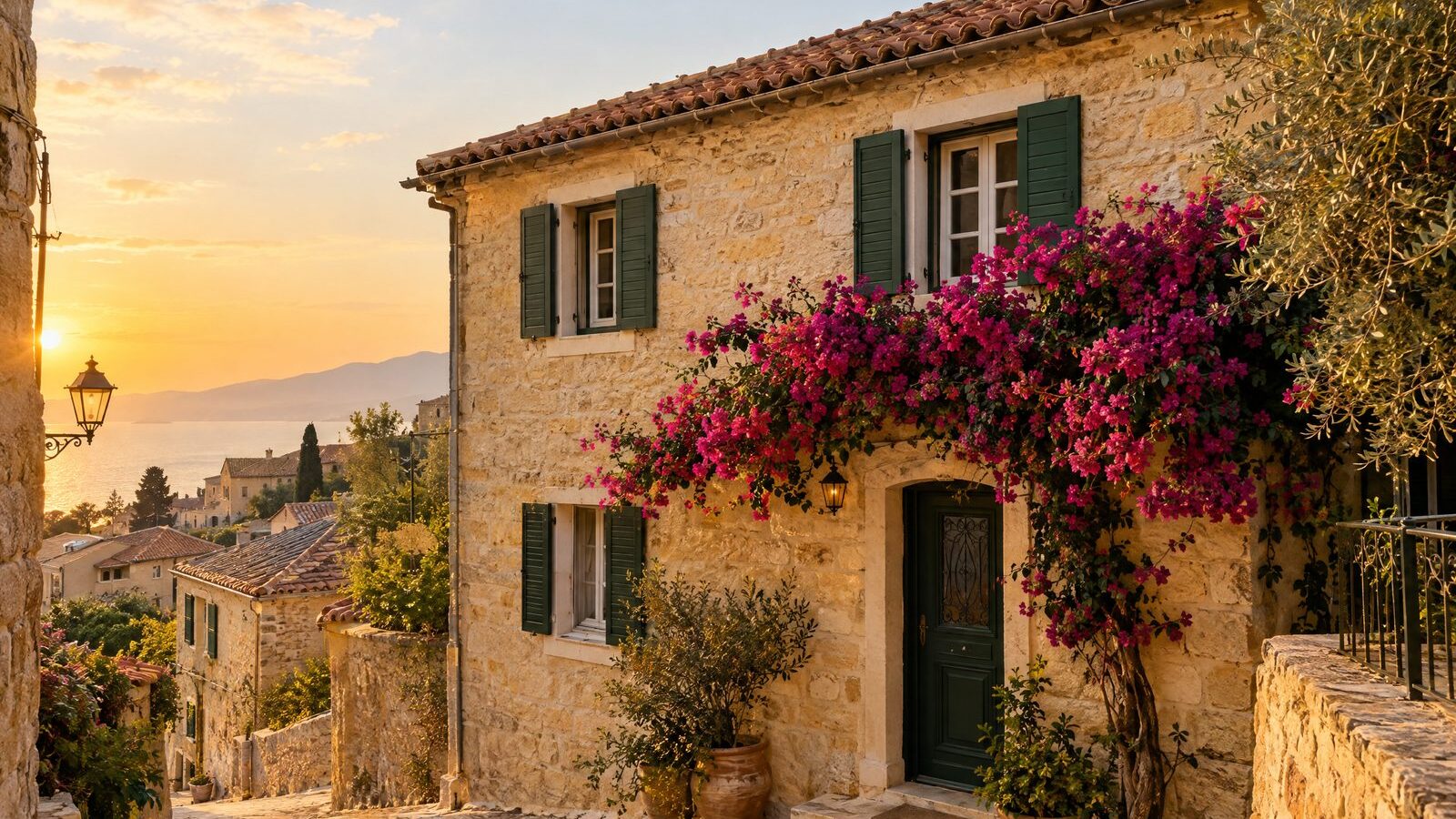
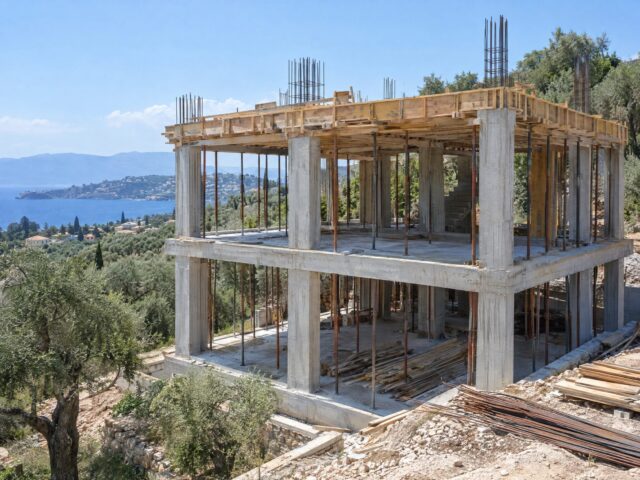
An old stone house in a Corfu village is a beautiful thing to own and an easy thing to underestimate. Before you buy one, or before the first hammer, there are six things to look at: the structure, the water, the roof, the mortar, the floors and foundations, and the access. This is the list we go through on every first visit, and it decides both the budget and the order of the works.
What is the structure really made of?
Most village houses have thick walls of local limestone, two outer faces with rubble between them, held by lime mortar and by the floors and the roof that tie the walls together. Look at the corners and the lintels above the openings, at bulges in the walls and at diagonal cracks around windows. A wall that has lost its ties, usually because a rotten floor was removed, moves outwards and needs a structural repair before anything else. The structural engineer decides whether the walls get new ties, a concrete ring beam under the roof, or local rebuilding.
Where does the water come from?
From three places: the roof and the broken gutters, the ground through walls without a damp proof course, and the cement patches that trap the moisture inside the stone. Dark stains low on the walls mean rising damp; stains high up mean the roof or a parapet. Water is the reason most old plaster has failed, and until the source is fixed, every new finish will fail too.
Is the roof worth saving?
The tiles often are, the timber often is not. A traditional roof with Byzantine or Roman tiles on timber rafters can be rebuilt with the same look, with insulation and a breathable membrane under the tiles. If the roof is a flat concrete slab added in the 1970s, check it for cracks and for how it sits on the stone walls; a heavy slab on soft walls is a structural question, not a roofing one.
Lime or cement for the old walls?
Lime. Always, for old limestone walls. Lime mortar and lime plaster are softer than the stone and let moisture out; cement is harder and traps it, so the stone decays around the hard joints and the plaster blows off. When you see grey cement patches on an old house, plan to remove them. We repoint with lime mortar in a colour matched to the original and replaster inside and out with lime.
What about the floors and the foundations?
Old houses rarely have foundations in the modern sense; the walls sit on rock or compacted ground. That is usually fine, as long as water does not wash the ground away. Ground floors are often laid directly on earth and are cold and damp; a new insulated slab with a membrane solves it and gives you underfloor heating if you want it. Upper floors on timber beams are checked beam by beam and replaced where the ends have rotted in the wall.
Can machines and materials reach the house?
In many villages the answer is only on foot for the last 30 metres. That is not a reason to give up, but it changes the budget: materials come in with small dumpers or by hand, the rubble goes out the same way, and a crane may be needed for the roof timbers. We walk the route on the first visit and price it.
In what order should the works go?
- structural repairs and ties, roof structure, drainage around the house
- removal of cement, repointing of the stone, new openings where the permit allows
- installations: electrics, plumbing, heating and cooling, drainage
- new ground floor slab with insulation, upper floors repaired
- lime plaster inside and out, windows and doors
- floors, bathrooms, kitchen, painting, the courtyard and the garden walls
Frequently asked questions
Can we keep the old stone exposed inside?
Yes, on a wall or two it looks wonderful. All of them exposed makes the house harder to heat and cool and hides the moisture problems. We usually expose one feature wall and plaster the rest in lime.
How long does a village house renovation take?
For a full renovation of a two-storey house usually six to twelve months on site, after the permit. Structural surprises are the main reason for delays, which is why the first inspection matters.
Do we need an architect for a renovation?
For the permit you need a licensed engineer in any case. An architect is worth it when the layout changes or the house is in a protected settlement where the facade is checked.
Based on how we assess village houses in Corfu as of October 2026. Every house is different; the engineer's inspection comes first.